
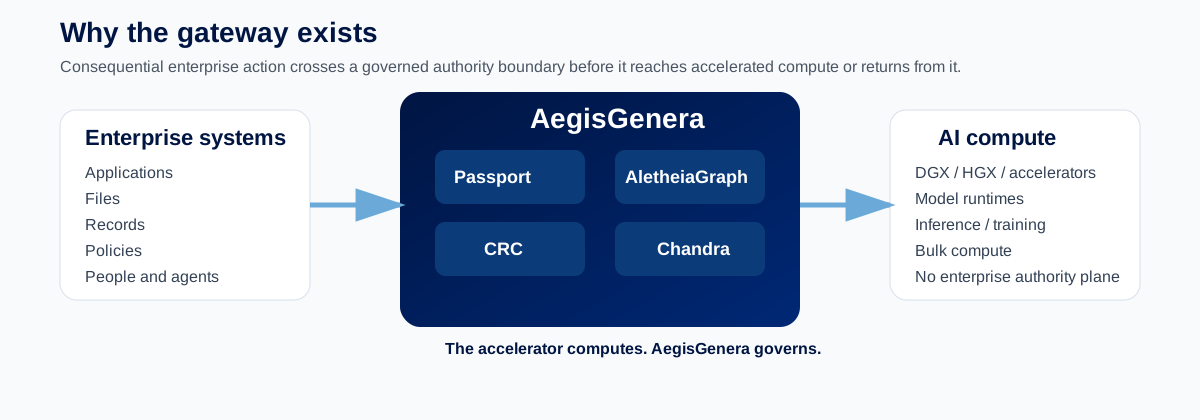
AegisGenera is the purpose-built computing platform for the General Reasoning stack. It begins with the mission of the machine, admits only the software required to fulfill that mission, and governs the boundary between enterprise authority and machine-speed AI compute.
AegisGenera does not begin with a general-purpose operating system and ask what can safely be removed. It begins with the work the machine exists to perform and asks what is justified in being present.
That changes the security model. A shell can belong because administration may require it. A compiler can belong because development may be part of the machine's mission. A debugger can belong because inspection may be necessary. Their presence is not ambient; it is justified. Their use is not casual; it is governed.
Autonomous agents and accelerated compute move at machine speed. Human-era infrastructure assumed that consequential judgment would happen somewhere between the database, the application, the operating system, and the human operator. That assumption no longer holds.
AegisGenera brings identity, authority, state, reasoning, and evidence into one controlled machine. Enterprise systems can remain optimized for operational roles. External AI systems can remain optimized for acceleration. AegisGenera is the place where the GR stack decides what may happen between them.
A BSD-derived operating environment built around the AegisGenera mission. AegisBSD defines the boot, storage, device, service, network, update, and recovery assumptions of the appliance. ZFS is the persistent storage foundation. The OS is not a neutral host beneath the product; it is the first enforcement layer of the machine.
AletheiaGraph provides authoritative persistence, graph traversal, query, provenance, reasoning, and truth evaluation. It is where the machine can distinguish stored fact, derived conclusion, proposed action, and the evidence connecting them.
Standalone AletheiaGraph includes open-source Chandra Core and GRIC. Chandra Core provides the Context Unit evidence and auditable usage-metering substrate without requiring a Chandra Enterprise license.
Chandra Enterprise is the governed CRUD and enterprise workflow platform of the GR stack. It uses the open Chandra Core Context Unit substrate for attributable, append-only evidence while adding the commercial enterprise structures, controls, deployment, federation, Marshaller, and operational services required to run governed business systems.
Chandra Passport is the governed identity and authority substrate for the GR environment. Humans, agents, applications, services, and machines are governed principals. Passport establishes identity, roles, scopes, and authority used throughout AegisGenera and the GR stack.
DXMachine is the governed workflow and agent-execution environment. It defines workflows, state machines, acceptance criteria, and the controlled transitions that turn reasoning into enterprise action.
GRIC provides health dashboards, resource maintenance, and file transfer for governed Chandra instances using a "Norton Commander"-like UI, instance password management, and instance deployment automation.
And, in the spirit of Symbolics Genera, the built-in Lisp development environment provides a coherent environment in which source, execution, inspection, debugging, and operation are not treated as unrelated products, but are first-class AegisGenera citizens.
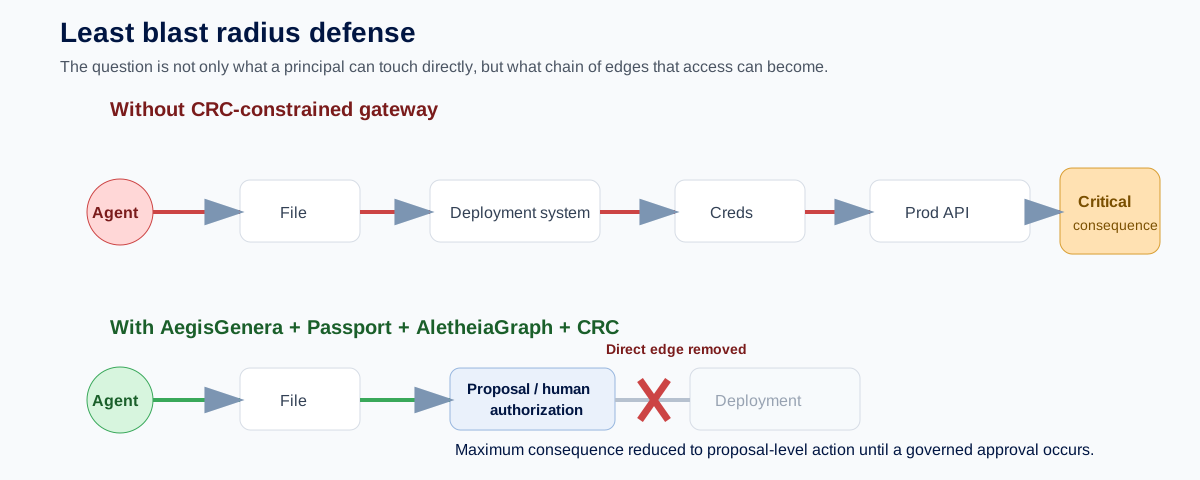
Autonomous agents do not attack systems one screen or one API at a time. They traverse relationships. Credentials lead to services. Services lead to data. Files lead to deployment systems. Identities lead to authority. Individually reasonable edges can compose into an unreasonable path.
AegisGenera exists to govern that graph before execution. Passport establishes the acting principal. AletheiaGraph represents and validates relevant relationships. CRC isolation surfaces bound traversable edges. Chandra records every consequential crossing. GRIC lets a human inspect the graph, the surfaces, the evidence, and the qualification results.
An edge is not merely “A can reach B.” It can carry identity, authority, direction, dependency, CRC surface, required approval, environment, lifecycle state, provenance, confidence, allowed operation, and consequence class.
Before a consequential traversal is permitted, the machine can ask: does this edge exist, is it authoritative, is the principal permitted, does it cross a protected surface, is human approval required, and is the prerequisite state satisfied? The result is not only allow or deny. It can also be propose — forcing a governed approval path where a direct edge would otherwise create unacceptable blast radius.
| Component | Question it answers |
|---|---|
| Passport | Who or what is acting, and under what authority? |
| AletheiaGraph | What edges exist, what do they mean, and what traversal is justified? |
| CRC surfaces | What boundaries should remain non-traversable or require escalation? |
| Chandra | What traversal actually occurred, in what sequence, and with what evidence? |
| GRIC | Can an operator inspect the graph, the surfaces, the attempt history, and the qualification results? |
Traditional least privilege asks what permissions a principal has. AegisGenera asks a harder question: what chain of edges can those permissions become? A system can have vulnerabilities and still have small blast radius. A system can be fully patched and still have catastrophic graph connectivity.
The goal is therefore not only to reduce permissions. It is to minimize the maximum consequence reachable from any compromised or misbehaving principal.
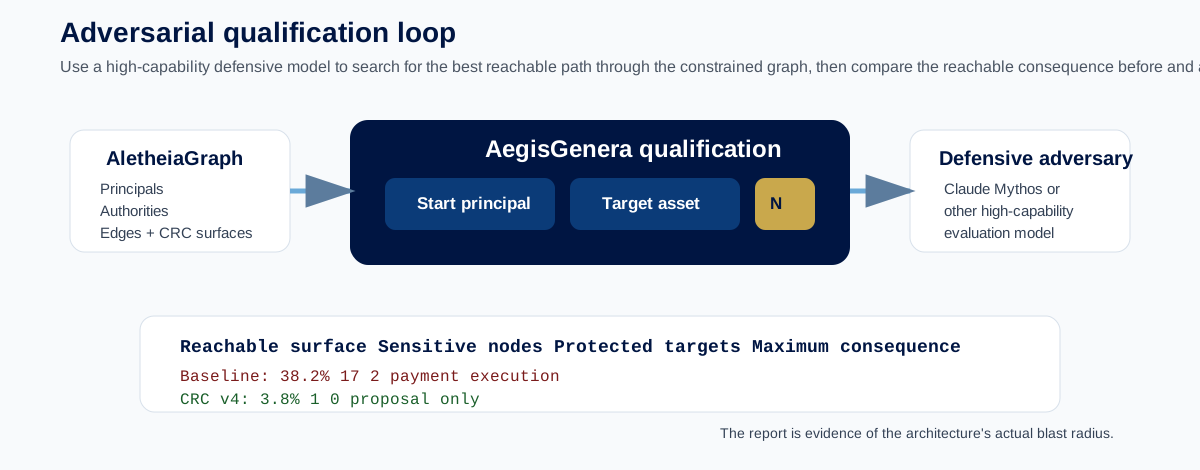
AegisGenera can do more than enforce structure. It can qualify it. AletheiaGraph can represent a deployment graph. Passport can define the starting principal and its authority. CRC can define the candidate isolation surfaces. Then a high-capability defensive model such as Claude Mythos can be used as an adversarial evaluator against the exposed graph.
The point is not to ask a model “is this secure?” The point is to ask it to find the best reachable path from a compromised or misbehaving principal toward a protected target, then compare that result before and after CRC constraints.
CRC DEFENSE QUALIFICATION

Principal:
  agent://claims-review-17

Protected targets:
  payment.execute
  identity.modify
  production.deploy
  customer.bulk-export

Evaluator:
  Claude Mythos (defensive evaluation)

Baseline architecture:
  Reachable graph:          38.2%
  Sensitive nodes reached:  17
  Protected targets:        2
  Maximum consequence:      payment execution

CRC-constrained architecture:
  Reachable graph:           3.8%
  Sensitive nodes reached:   1
  Protected targets:         0
  Maximum consequence:       proposal only
That is the gateway story. Do not ask whether the agent is trustworthy. Ask what the graph permits it to reach when it is not.
Symbolics demonstrated the value of a coherent environment in which source, execution, inspection, debugging, and operation were not treated as unrelated products. AegisGenera does not reproduce historical Genera, but it deliberately revives that systems idea.
The GR Infrastructure Console is your private network CRC fleet console, and it is also the Lisp development environment of the machine. An authorized operator should be able to move continuously between source, running SBCL processes, warnings, tests, logs, deployment state, Chandra evidence, and AletheiaGraph inspection without treating each as an unrelated tool.
Discover local GR projects and ASDF systems, inspect system definitions, and visualize dependency and source-tree relationships.
Source editor, REPL/evaluation surface, compile/load/reload commands, and source-tree-aware navigation for the live SBCL environment.
Run qualification suites, navigate warnings and errors back to source, inspect output, and preserve the relationship between code, test, and machine state.
Control remote SBCL processes, inspect logs, compare deployments, copy approved artifacts, and operate fleets without leaving the governed console.
Navigate Context Units, graph state, indexes, query/reasoning behavior, provenance, and operational diagnostics from the same environment used to administer the machine.
The ancestry is intentional: source, execution, inspection, and operation should feel like one coherent environment. GRIC carries that idea forward on AegisBSD, SBCL, AletheiaGraph, and Chandra.
Configuration, deployment, service control, firmware and storage administration, machine identity, diagnostics, recovery, remote SBCL control, logs, and deployment comparison/copy operations.
Project/system browser, ASDF discovery and dependency view, source editor, REPL/evaluation, compile/load/reload, warning/error navigation, source-tree-aware browsing, and qualification tooling.
Graph inspectors, Chandra diagnostics, storage and network diagnostics, health tools, forensic and qualification utilities. Inspection exists to understand the machine, not to accumulate a generic monitoring stack.
Persistence, query, Prolog-facing reasoning, planner/executor machinery, provenance, truth evaluation, CRC-aware traversal, and the tools necessary to inspect those operations.
DXMachine provides governed workflow and agent execution. Chandra Enterprise, Marshaller, CFS and other GR applications operate inside the same identity, reasoning, evidence, and machine-control environment.
Consumer applications, unrelated databases, arbitrary third-party agents, generic collaboration stacks, convenience software, or ambient services with no defined role in the AegisGenera mission.
Production access requires a meaningful commercial commitment. That commitment is financial, not operational: customers are never required to manufacture transactions or Context Units simply to retain a license.
Source access is part of the product. Because GR applications are live Lisp systems, authorized customers receive the proprietary source required to operate, inspect, compile, debug, and administer the licensed environment. Source delivery does not transfer ownership, redistribution rights, or commercialization rights.
The commercial model separates an initial proprietary source entitlement, a minimum annual production commitment, and governed-work settlement. OEM, redistribution, embedded, hosted resale, or other re-commercialization rights require a separate written agreement.
GR commercial software is distributed under a proprietary commercial source license within an authorized deployment scope. Standard production rights do not include redistribution, sublicensing, resale, or re-commercialization. Those rights require a separate written OEM or redistribution agreement.
General Reasoning does not price the stack by human seat or agent population. Commercial deployments combine a platform entitlement with usage-based settlement for standardized classes of governed autonomous work.
Context Units belong to the organization whose governed environment created them and remain inside that organization's evidentiary domain. Chandra Core preserves that local evidence. General Reasoning reconciles agreed aggregate usage, not customer CUs, graph content, business records, principal identities, exact event timing, or workflow detail.
Immutable, attributable records of what happened. They are not fungible and are never redeemed or traded.
Commercial agreements settle standardized classes of governed work from aggregate usage statements and cryptographic commitments. Customer CUs, graph content, event timing, identities, and workflow detail do not become market data.
Healthcare, financial-services, energy, and other sectors can price different classes of work without creating separate currencies.
Qualifying enterprise agreements can establish future prices or capacity for standardized governed-work classes without turning Context Units into tradable assets.
The AG-R1 reference appliance is a 2U single-socket AMD EPYC system with approximately 1.15 TB ECC memory, separate mirrored NVMe storage classes for boot, AletheiaGraph data, WAL, and Chandra evidence, dedicated management, a high-speed enterprise network plane, and a separate AI-compute network plane.
None of those components is exotic. The product boundary is the controlled definition: exact BOM, approved firmware set, device topology, AegisBSD image, software manifest, qualification suite, machine identity, and per-unit birth record.